
Compare KKHSOU and IGNOU: Fees, Courses, Recognition and Exams
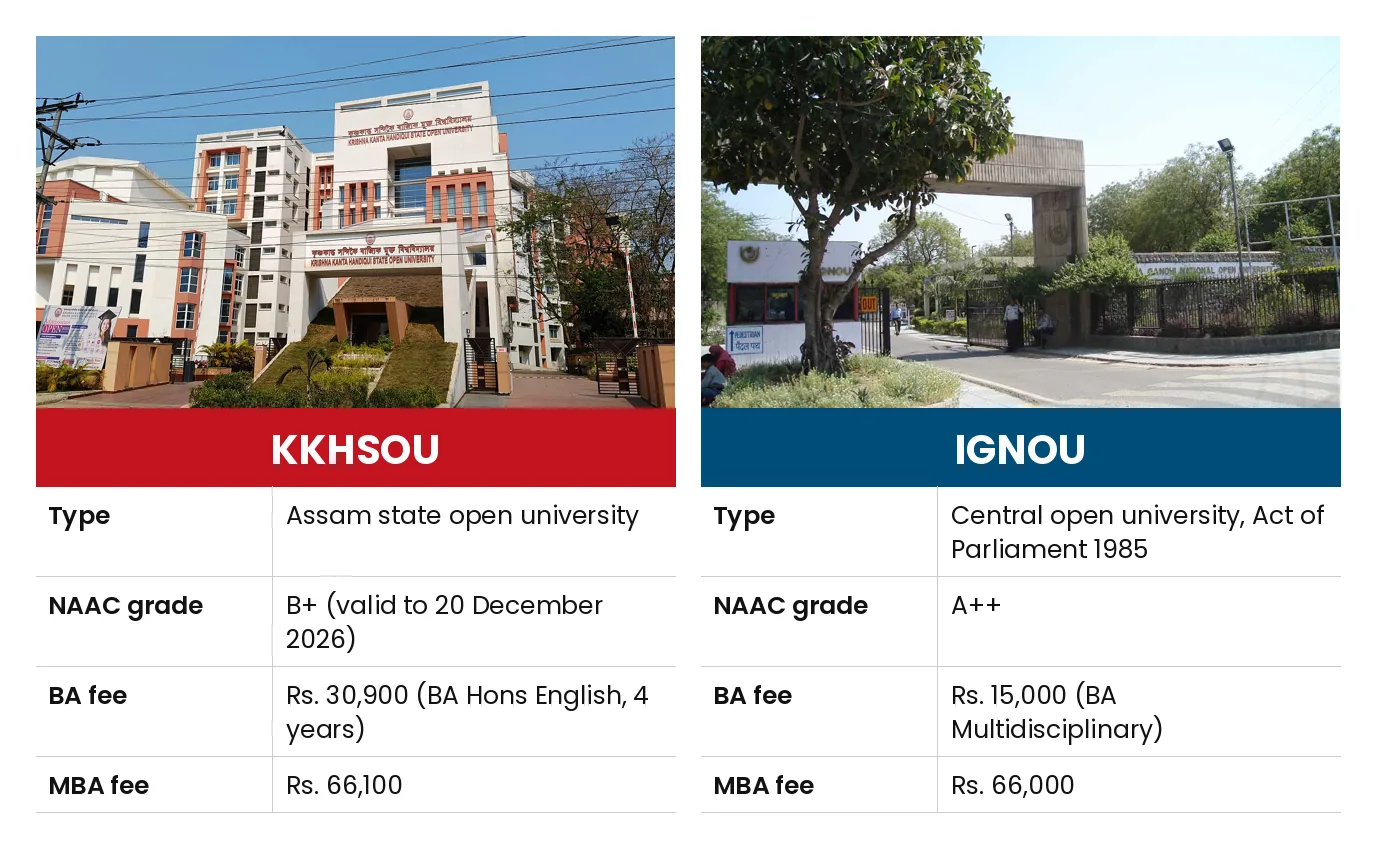
KKHSOU vs IGNOU: type of university, Act and study modes
KKHSOU and IGNOU are both open universities, but they differ in their establishment and territorial jurisdiction. KKHSOU is a State Open University, founded under the KKHSOU Act, 2005, by the Government of Assam. IGNOU is a National Open University, established by the IGNOU Act, 1985, an Act of Parliament.
KKHSOU began operations on 11 December 2006, with its headquarters in Patgaon, Rani, Guwahati. It is described as the sole State Open University in North East India. IGNOU was established earlier, in 1985, and its headquarters are in New Delhi. KKHSOU states it has no study centres outside Assam, and admission is through its 343 study centres within the state.
Both universities offer programmes through Open and Distance Learning (ODL) mode. KKHSOU’s 2026-27 UGC-DEB rows are all ODL. IGNOU offers programmes through both ODL and Online modes, though KKHSOU is listed by UGC-DEB (2026-27) as “Krishna Kanta Handiqui State Open University, Assam,” while IGNOU is listed as “Central Open University, Delhi.”
| Point | KKHSOU | IGNOU |
|---|---|---|
| Institution type and name | Krishna Kanta Handiqui State Open University (KKHSOU), a State Open University founded under the KKHSOU Act, 2005 (Government of Assam); described as the sole State Open University in North East India State Open University, Assam; listed as “Krishna Kanta Handiqui State Open University” |
National Open University established by an Act of Parliament (central open university) Central Open University, Delhi |
| Founding Act | KKHSOU Act 2005 enacted by the Assam Legislative Assembly and notified in the Assam Gazette (extraordinary) on 29 September 2005 | IGNOU Act, 1985 (Act No. 50 of 1985) |
| Year established | Started operation on 11 December 2006 (first Vice-Chancellor Prof. Srinath Baruah) | 1985 |
| Headquarters location | Patgaon, Rani, Guwahati 781017, Assam; described as the 14th Open University in India | New Delhi (Maidan Garhi, New Delhi-110068) |
| Number of Schools | 7 Schools of Studies, named after personalities of Assam | 21 Schools of Studies |
| Delivery modes | Open and Distance Learning (ODL); course pages list “Course mode: Distance”; 2026-27 UGC-DEB rows are all ODL | Programmes are offered through Open and Distance Learning (ODL) and Online modes |
KKHSOU only
- City campus address: NH 27, Resham Nagar, Khanapara, Guwahati 781022
- North East India presence: The only university in North East India that runs through ODL mode (per its brochure)
- Territorial jurisdiction: No study centre outside Assam; admission is through study centres in Assam
- Migration certificate: KKHSOU does not insist on a migration/transfer certificate for enrolment
- MA admission criteria: Admission to an MA is allowed even without the specific subject at graduation level (FAQ)
- Simultaneous programmes: Two UG/PG programmes may be pursued simultaneously (UGC April 2022 guidelines); a KKHSOU learner must join the second programme in a different cycle
- New online programmes: Vice-Chancellor’s message says KKHSOU is launching fully online MA programmes in Assamese and English
- UG programmes offered: BA (Hons) in Assamese, Economics, Education, English, History, Philosophy, Political Science, Sociology; BBA; BCom; BCA; BSc (Hons) Mathematics; plus 1-year BLISc
IGNOU only
- First programmes and intake: Began in 1987 with two programmes (Diploma in Management, Diploma in Distance Education) and 4,528 students
- Elective/course change: Allowed within 30 days of receiving the first set of course material, on payment of a fee
KKHSOU books and centres: KKHSOU Study Centre List and KKHSOU Study Material PDF Free Download.
KKHSOU vs IGNOU: UGC-DEB approval and NAAC grade
IGNOU holds an A++ NAAC grade, while KKHSOU has a B+ grade, valid up to 20 December 2026, from its first cycle assessment as an ODL university. IGNOU is also ranked No. 1 among Open Universities in NIRF 2024 and 2025.
IGNOU is exempt from the UGC (ODL Programmes and Online Programmes) Regulations, with its programmes considered at par with those approved by the UGC-Distance Education Bureau. KKHSOU was empowered by UGC letter F.9-13/2008(CPP-I) dated 18 March 2009 to confer degrees under Section 22 of the UGC Act, 1956. Its UG and PG programmes launched with DEB/UGC approval, File No. 8-7/2023 (DEB-I) (ODL).
The Government of Assam recognises all KKHSOU degrees, diplomas, and certificates for government jobs and higher studies. IGNOU states its degrees, diplomas, and certificates are recognised by all member institutions of the Association of Indian Universities and are at par with awards from all Indian universities. Both universities state that their ODL degrees are equivalent to those from traditional universities.
For specific programmes, IGNOU’s MBA and MCA programmes hold AICTE recognition from 2022-23 to 2026-27. KKHSOU states its MBA is “UGC & AICTE Recognised” and is offered only at its Khanapara Campus study centre for the July 2026 session.
| Point | KKHSOU | IGNOU |
|---|---|---|
| UGC-DEB programme list | 34 programmes listed for 2026-27 (July) in ODL mode only: 13 UG rows (8 BA Hons, BBA, B.Com, BCA, BSc Hons Mathematics – all 4-year – plus BLIS) and 21 PG rows; no Online-mode rows UGC-DEB order F.No. 5-5/2026(DEB/R-4), August 2026: 4 new ODL programmes recognised – BSc (Hons) Mathematics (4 years), MSc Physics, MSc Chemistry, Master of Library & Information Sciences (1 year); none rejected |
IGNOU ODL programmes are listed on the UGC-DEB “Know your Program” list for 2026-27, July session (125 ODL rows and 16 Online rows counted for 2026-27) |
| NAAC grade | B+ (CGPA 2.68 on a four-point scale), first cycle, valid up to 20 December 2026 | A++ |
| MBA approvals | MBA described as “UGC & AICTE Recognised”; offered only at the University Khanapara Campus study centre (code 1500) (July 2026 (2026-27)) | AICTE recognition of MBA and MCA from 2022-23 to 2026-27 |
| ODL degree equivalence | Degrees/diplomas/certificates of DEC/UGC-recognised ODL institutions are to be treated as equivalent to those of traditional universities | UGC regulation quoted by IGNOU: UG/PG degrees and PG diplomas through ODL or Online mode are treated as equivalent to conventional-mode awards |
| Original certificate issuance | Provisional pass certificate sent to study centres; original pass certificate issued only after the convocation | Degree, diploma and certificate are available through DigiLocker |
KKHSOU only
- UGC degree conferment power: UGC letter F.9-13/2008(CPP-I) dated 18 March 2009 empowered KKHSOU to confer degrees under Section 22 of the UGC Act, 1956
- Original DEC recognition: Recognised by the former Distance Education Council (now DEB, UGC) by letter DEC/Misc/07/5957 dated 3 October 2007
- UGC Section (f) listing: Included in the UGC list of universities under Section 2(f) of the UGC Act, 1956 (UGC letter F.9-13/2008 (CPP-I/PU), February 2020)
- DEB approval for programmes: UG and PG programmes launched with DEB/UGC approval, File No. 8-7/2023 (DEB-I) (ODL)
- Recognition period: From the 2026-27 session (August 2026) to 2030-31 (up to January-February 2031 only)
- NAAC cycle and visit: Cycle 1; NAAC peer team visit 16-18 December 2021; assessed as an ODL university
- Government job recognition: Government of Assam recognises all KKHSOU degrees, diplomas and certificates for government jobs and higher studies
- Original certificate fee: Rs 535, online application; only for batches whose convocation has been held
- Marksheet and provisional certificate fees: Rs 100 for consolidated marksheet and Rs 235 for provisional certificate, paid at admission to the final semester (July 2026 (2026-27))
IGNOU only
- NIRF rank: No. 1 among Open Universities in NIRF 2024 and 2025
- UGC ODL regulations exemption: IGNOU is exempted from the UGC (ODL Programmes and Online Programmes) Regulations
- Programme standing: IGNOU programmes are at par with programmes approved by the UGC-Distance Education Bureau
- AIU recognition: Degrees, diplomas and certificates recognised by all member institutions of the Association of Indian Universities; Recognised by all AIU member universities; at par with degrees/diplomas/certificates of all Indian universities
Who can join KKHSOU and who can join IGNOU
IGNOU states that it is open to all, with no age or region bar, making it accessible for students across India, including those in Assam.
IGNOU has a pan-India geographic reach and operates 25 Overseas Study Centres in 15 countries. Foreign students residing in India are eligible for selected IGNOU programmes if they hold a valid student visa for the minimum duration of the programme.
A student may pursue two academic programmes simultaneously through ODL/Online mode at IGNOU, subject to certain conditions.
IGNOU only
- Access for all: Access for all irrespective of age, region, religion and gender
- Geographic reach: Pan-India, plus 25 Overseas Study Centres in 15 countries
- Foreign students: Eligible for selected programmes if they hold a valid student visa for the minimum duration of the programme
- Simultaneous programs: A student may pursue two academic programmes simultaneously through ODL / Online mode (conditions apply)
KKHSOU student services
Courses at KKHSOU and IGNOU
KKHSOU’s 4-year Bachelor of Arts (Hons) in English has a total fee of Rs. 30,900. Eligibility for most KKHSOU undergraduate degrees requires 10+2 or equivalent, while IGNOU also has a 10+2 entry requirement for most of its undergraduate programmes. IGNOU’s FYUP undergraduate programmes from the July 2025 admission session allow for multiple entry and exit points. KKHSOU also states that exit with a 3-year degree is possible for its 4-year FYUGP Bachelor’s degrees.
IGNOU only
- General BA on offer: Bachelor of Arts (BAM), a multidisciplinary 3-year degree under the FYUP framework
- Four-year UG programmes: Exit after 3 years (120 credits) gives a Degree with Major; 4 years (160 credits) gives a Degree with Honours
- Multiple entry and exit: Multiple Entry and Multiple Exit Scheme applies to FYUP undergraduate programmes from the July 2025 admission session
- CBCS BA Honours credits: BA (Honours) under CBCS: 148 credits in a minimum of six semesters (three years)
- One-year Master’s programmes: One-year MA (e.g. MA English, MAEGOY) for holders of a four-year Bachelor’s degree with Honours / Honours with Research; minimum 1 year, maximum 2 years, Rs. 8,200 total
- Continuing learners programmes: BAG and BCOMG appear in the programme-code list of the December 2026 term-end date sheet (December 2026 TEE)
- Diploma in Early Childhood: Diploma in Early Childhood Care and Education (DECE): 10+2 or equivalent; 1 to 3 years; Rs. 4,000 (July 2026)
- Diploma in Nutrition: Diploma in Nutrition & Health Education (DNHE): 10+2 or equivalent; 1 to 3 years; Rs. 4,000 (July 2026)
- Certificate in Environmental Studies: Certificate in Environmental Studies (CES): 10+2 or equivalent; 6 months to 2 years; Rs. 2,900 (July 2026)
- Degree entry requirement: BCA_NEW: 10+2 or its equivalent, or a pass in Diploma in Commercial Practice or equivalent (see the programmes list for the other degrees, all 10+2)
- Certificate in Information Technology: 10th pass; 6 months to 2 years; Rs. 6,200
- Certificate in Water Harvesting: 10th pass; 6 months to 2 years; Rs. 2,900
- Certificate in Home Based Health Care: 10th pass (Matriculation); 6 months to 2 years; Rs. 2,900
- Certificate in Energy Technology: 10th pass; 6 months to 2 years; Rs. 3,200
- Certificate in Food and Nutrition: No formal qualification, minimum age 18; 6 months to 2 years; Rs. 2,600
- Levels of awards: Certificates, Diplomas, Advance Diplomas, Post Graduate Diplomas and Degrees
- Number of programmes: 325 programmes
Minimum and maximum duration
| Programme | KKHSOU duration | IGNOU duration |
|---|---|---|
| BBA / BMS | 4 years (8 semesters) to 8 years | 3 years to 6 years |
| BCA | 4 years (8 semesters) to 8 years | 3 years to 6 years |
| BA | 4 years (8 semesters); exit with 3-year degree possible to 8 years | 3 years to 6 years |
| MBA | 2 years (4 semesters) to 4 years | 2 years to 4 years |
| M.Com | 2 years (4 semesters) to 4 years | 2 years to 4 years |
| MA Hindi | 2 years (4 semesters) to 4 years | 2 years to 4 years |
| MA History | 2 years (4 semesters) to 4 years | 2 years to 4 years |
| MA Political Science | 2 years (4 semesters) to 4 years | 2 years to 4 years |
| MA English | 2 years (4 semesters) to 4 years | 2 years to 4 years |
| MA Economics | 2 years (4 semesters) to 4 years | 2 years to 4 years |
Eligibility as published
| Programme | KKHSOU eligibility | IGNOU eligibility |
|---|---|---|
| BBA / BMS | 10+2 or equivalent (any stream incl. vocational) from a UGC-recognised Council/University, or three-year polytechnic diploma | 10+2 passed or its equivalent |
| BCA | 10+2 or equivalent (any stream incl. vocational) from a UGC-recognised Council/University | 10+2 or its equivalent, or a pass in Diploma in Commercial Practice or equivalent |
| BA | 10+2 or equivalent (any stream incl. vocational) from a UGC-recognised Council/University, or three-year polytechnic diploma | 10+2 or its equivalent |
| MBA | Any graduate with 50% marks (General) / 45% (reserved category); admission page says no entrance test | Bachelor Degree of minimum 3 years duration with at least 50% marks (45% for reserved category) |
| M.Com | Any graduate from KKHSOU or any other UGC-recognised university | Bachelor’s Degree or a higher degree from a recognized University |
| MA Hindi | Any graduate from KKHSOU or any other UGC-recognised university | Bachelor’s Degree or a higher degree from a recognized University |
| MA History | Any graduate from KKHSOU or any other UGC-recognised university | Bachelor’s Degree or a higher degree from a recognized University |
| MA Political Science | Any graduate from KKHSOU or any other UGC-recognised university | Bachelor’s Degree or a higher degree from a recognized University |
| MA English | Any graduate from KKHSOU or any other UGC-recognised university | Bachelor’s Degree or a higher degree from a recognized University |
| MA Economics | Any graduate from KKHSOU or any other UGC-recognised university | Bachelor’s Degree or a higher degree from a recognized University |
KKHSOU course pages: KKHSOU Original Certificate Application Form; KKHSOU Syllabus; KKHSOU Distance MA Admission and KKHSOU Diploma Courses List.
Fee of each course at KKHSOU and IGNOU
For postgraduate studies, KKHSOU’s Master of Arts in English costs Rs. 24,700 over two years, paid in four semesters. IGNOU’s Master of Arts (English) costs Rs. 16,400 over two years, paid annually.
KKHSOU offers a fee waiver for differently abled learners in all semesters, jail inmates, and learners from adopted villages for the July 2026 session. IGNOU provides programme fee exemption for SC/ST students and prison inmates for the July 2026 session. IGNOU learners are also eligible for Government of India scholarships through the National Scholarship Portal.
KKHSOU’s refund policy follows the UGC Fee Refund Policy (D.O. F.2-7/2022, 12 June 2024), offering a 100% refund if withdrawal occurs 15 or more days before the last date. IGNOU refunds fees if an application is cancelled before admission confirmation for the July 2026 session, deducting 15% of the programme fee, capped at Rs. 2,000, if cancelled after confirmation. No refund is given after 60 days from the closing date of admissions.
KKHSOU only
- Fee structure: Fees are charged per semester: a 1st-semester fee at admission and a slightly lower fee from the 2nd semester onwards (July 2026 (2026-27))
- Additional fees: Rs 1,200 project fee and Rs 250 practical fee extra where applicable (July 2026 (2026-27))
- Differently abled fee waiver: Fee waiver for differently abled learners (all semesters), jail inmates and learners of the university’s adopted villages (July 2026 (2026-27)); Waiver in all semesters on submission of Form IV / disability certificate, to be claimed at first-semester admission (July 2026 (2026-27))
- Admission cancellation: Admission cancelled and fee not refunded if misinformation or invalid documents are detected
IGNOU only
- SC/ST fee exemption: Programme fee exemption for SC/ST students as per University policy (policy reviewed every admission cycle) (July 2026)
- Jail inmate fee waiver: Prison inmates are exempt from programme fee including registration fee (July 2026)
- Government scholarships: IGNOU learners are eligible for Government of India scholarships via the National Scholarship Portal
- Disability study duration: Two extra years beyond the maximum duration for learners with 40% or more disability (July 2026)
Fees of the programmes both run, as each publishes them
| Programme | KKHSOU fee | IGNOU fee |
|---|---|---|
| BBA / BMS | Rs 5,050 (1st semester) + Rs 4,950 per semester (July 2026 (2026-27)) | Rs. 10,500 per year (July 2026) |
| BCA | Rs 5,600 (1st semester) + Rs 5,500 per semester (July 2026 (2026-27)) | Rs. 8,300 per semester (July 2026) |
| BA | Rs 3,950 (1st semester) + Rs 3,850 per semester from 2nd semester (July 2026 (2026-27)) | Rs. 5,000 per year (July 2026) |
| MBA | Rs 16,600 (1st semester) + Rs 16,500 per semester (July 2026 (2026-27)) | Rs. 16,000 per semester for semesters I, II and IV; Rs. 18,000 for semester III (July 2026) |
| M.Com | Rs 6,250 (1st semester) + Rs 6,150 per semester (July 2026 (2026-27)) | Rs. 10,200 per year (July 2026) |
| MA Hindi | Rs 6,250 (1st semester) + Rs 6,150 per semester (July 2026 (2026-27)) | Rs. 8,200 per year (July 2026) |
| MA History | Rs 6,250 (1st semester) + Rs 6,150 per semester from 2nd semester (July 2026 (2026-27)) | Rs. 8,200 per year (July 2026) |
| MA Political Science | Rs 6,250 (1st semester) + Rs 6,150 per semester from 2nd semester (July 2026 (2026-27)) | Rs. 8,200 per year (July 2026) |
| MA English | Rs 6,250 (1st semester) + Rs 6,150 per semester from 2nd semester (July 2026 (2026-27)) | Rs. 8,200 per year (July 2026) |
| MA Economics | Rs 6,250 (1st semester) + Rs 6,150 per semester from 2nd semester (July 2026 (2026-27)) | Rs. 9,500 per year (July 2026) |
KKHSOU fees in full: KKHSOU Payment Receipt Download Portal Process for July 2026 Session.
When and how to apply to KKHSOU and IGNOU
KKHSOU and IGNOU both offer two admission cycles per year, in January and July. For the July 2026 session, KKHSOU’s admission notification was published on 1 July 2026, with the last date extended to 13 October 2026. IGNOU also extended its last date for fresh admissions for the July 2026 cycle to 13 October 2026, excluding Certificate and Semester-based programmes.
Applicants to KKHSOU for the July 2026 session must create an ABC ID and a UGC-DEB ID before logging into the online admission portal. The portal is open daily from 6 am to 11:59 pm. IGNOU requires applicants to have their APAAR ID ready and apply through its ODL admission portal. IGNOU charges a non-refundable registration fee of Rs. 300 and a University Development fee of Rs. 400, both payable at admission besides the programme fee.
KKHSOU requires applicants to upload a photo, final marksheet, photo ID, signature, and any applicable caste or PwD certificates, with files under 500 KB. IGNOU specifies a colour passport-size photograph under 100 KB, and qualification proof and category certificates under 200 KB. For specific programmes, KKHSOU states that MBA, MSc IT, BLISc, and M.Lib.I.Sc. are offered only at the Khanapara Campus study centre. MSc Chemistry has a seat capacity of 100 at Khanapara and 90 at Arya Vidyapeeth College for July 2026, both of which are shown as reached.
| Point | KKHSOU | IGNOU |
|---|---|---|
| Last date for July | Extended to 13 October 2026 (earlier 30 September 2026, now struck out on the page) (July 2026) | 13 October 2026 (except Certificate and Semester-based programmes) (July 2026) Last date for the Online Fresh Admission Form (ODL and Online) extended up to 13 October 2026 (July 2026) Earlier extended till 30 September 2026, except Semester based and Certificate programmes (July 2026) |
| Admission cycles | Two cycles a year: July (summer) and January (winter) (July 2026 (2026-27)) | Two cycles a year: January and July (July 2026) |
| Admission mode | Online only, for all semesters (July 2026 (2026-27)) | Fully online; no printed form needs to be sent to the Regional Centre |
| Admission portal and helpline | Portal open 6 am to 11:59 pm daily; helpline 7099096070, 7099096071, 8638467243 (9 am-5 pm, Mon-Sat); admission@kkhsou.in (July 2026) | ignouadmission.samarth.edu.in/ (July 2026) |
| Prerequisites to apply | Create an ABC ID and a UGC-DEB ID, then log in to the admission portal (July 2026 (2026-27)) | Applicants are told to keep their APAAR ID ready before applying |
| Documents to upload | Photo, final marksheet/certificate of last qualification, photo ID (PAN/Driving Licence/Aadhaar), signature, PwD/caste/BPL certificate if applicable (files under 500 KB) (July 2025 (admission-process PDF still linked as current)) | Colour passport-size photograph, white background, under 100 KB JPEG Soft copy of the relevant educational qualification, under 200 KB, JPEG/PDF Soft copy of category certificate if SC/ST/OBC, under 200 KB |
KKHSOU only
- Admission notification: Admissions for the July 2026 session to start 1 July 2026 (Registrar’s notification KKHSOU/Admission/15/2026/4 dated 30-06-2026)
- Continuous admission: Each subsequent semester requires fresh admission by paying the semester fee, regardless of the previous semester’s result (July 2026 (2026-27))
- Programmes at Khanapara campus: MBA, MSc IT, BLISc and M.Lib.I.Sc. are offered only through the University Khanapara Campus study centre (code 1500); MSc Physics/Chemistry at named centres with seat caps (July 2026)
- MSc Chemistry seats: Seat capacity 100 at Khanapara campus and 90 at Arya Vidyapeeth College; both shown as reached (July 2026)
- Change of elective: Allowed within two months of the last admission date on payment of Rs 500 plus SLM cost
IGNOU only
- Current admission cycle: July 2026 cycle
- Re-registration July: Online re-registration extended till 30 September 2026 with late fee of Rs. 200 (July 2026)
- Registration fee: Rs. 300, non-refundable, paid at admission in addition to the programme fee (July 2026)
- University Development fee: Rs. 400, paid at admission in addition to the programme fee (July 2026)
- Payment modes: Net banking, debit/credit card or UPI through the payment gateway
- Re-admission after duration: Students who cannot finish within the maximum time can seek readmission and apply for credit transfer (January 2026)
KKHSOU admission this session: KKHSOU Admission 2026; KKHSOU MA and How to Apply Online for KKHSOU Convocation.
Books, counselling and study centres at KKHSOU and IGNOU
IGNOU provides printed self-instructional study material as a print book or e-book. Students opting for digital material receive a 15% discount on the programme fee.
IGNOU’s self-learning material for over 3923 courses across 384 programmes is available on its eGyanKosh repository. Counselling sessions are held if you look at the schedule set by the Learner Support Centre. Attendance at practical sessions is compulsory for programmes with practical components. One credit at IGNOU equals 30 hours of learner study.
IGNOU also offers technology-enabled support through Gyan Darshan, Gyan Vani, Swayam Prabha, and web-based resources.
IGNOU only
- Study material format: Printed self-instructional study material is provided as a print book and/or e-book
- Digital material discount: 15% discount on the programme fee for learners who opt for soft copy instead of printed material
- Online material repository: Self-learning material of over 3923 courses of 384 programmes is on eGyanKosh
- Counselling sessions: Counselling sessions are held as per the schedule drawn up by the Learner Support Centre
- Practical sessions attendance: Attendance at practical sessions is compulsory where a programme has practicals
- Credit hour definition: One credit equals 30 hours of learner study
- Broadcast and online support: Technology-enabled support through Gyan Darshan, Gyan Vani, Swayam Prabha and web-based support
- Number of Regional Centres: 67 Regional Centres (including Recognised Regional Centres); Nation-wide network of 67 Regional Centres; Over 69 Regional Centres and 2,000+ Learner Support Centres
- Number of Learner Support Centres: Nearly 2000 Learner Support Centres
Assignments, term-end exams and results at KKHSOU and IGNOU
KKHSOU requires a handwritten home assignment of 50 marks, with five compulsory 10-mark questions, for the July 2026 session. This submission is mandatory to sit the semester-end examination. IGNOU states that assignment responses must be written leading up to taking the Term-End Examination for the July 2026 session, and assignments for the current session are available for download from its website. Tutor Marked Assignments go to the Coordinator of the learner’s Learner Support Centre.
For the July 2026 session, KKHSOU’s formative (internal) assessment carries 30% weightage, and the summative (term-end) assessment carries 70%. IGNOU’s weightage for assignments is 30% and for the Term End Examination is 70% for its B.Com, BCOMF, MBA (January 2026 handbook), and MCA_NEW (July 2025 programme guide) programmes. For BCA core courses (May 2026 programme guide), continuous evaluation is 25% and the term-end examination is 75%.
KKHSOU holds term-end examinations once for odd semesters and once for even semesters each year for the July 2026 session. IGNOU conducts term-end examinations twice a year, in June and December, throughout the country. For the December 2026 TEE, IGNOU has two daily exam sessions: 10 AM to 1 PM and 2 PM to 5 PM. The examination fee for KKHSOU is included in the semester fee paid at admission for the July 2026 session, while IGNOU charges Rs. 200 per theory course for the December 2026 TEE. IGNOU also charges Rs. 300 for projects and practical exams up to 4 credits, and Rs. 500 above 4 credits, from the January 2023 admission cycle.
KKHSOU publishes results on its website with e-marksheets and offers re-scrutiny, revaluation, and photocopies of answer scripts. IGNOU states that for its MCA_NEW programme (July 2025), a learner needs at least 40% in assignments and 40% in the term-end examination, with an overall 40%. For the BCOMF programme, at least 35% (Grade D) is required separately in assignments and the term-end examination of each course.
| Point | KKHSOU | IGNOU |
|---|---|---|
| Assessment weightage | Formative (internal) 30%, summative (term-end) 70%; pass mark 40% per course | Assignments 30%, Term End Examination 70% Assignments 30%, term-end examination 70% (January 2026) Assignment 30%, term-end examination 70% (July 2025) BCA core courses: continuous evaluation 25%, term end examination 75% (May 2026) |
| Term-end exam frequency | Held once for odd semesters and once for even semesters each year (July 2026 (2026-27)) | Twice a year: June and December (July 2026) Twice a year in June and December, throughout the country |
| Exam fee | Included in the semester fee paid at admission; no fee at the time of submitting the exam form (July 2026 (2026-27)) | Rs. 200 per theory course (December 2026 TEE) |
KKHSOU only
- Pass mark: 40% in each subject
- Assignment format: Handwritten home assignment of 50 marks (five 10-mark questions) submitted to the study centre; submission is mandatory to sit the semester-end exam (July 2026 (2026-27)); 50 marks, five compulsory questions of 10 marks each (July 2026 (2026-27))
- Back / betterment paper fee: Rs 750 per paper (UG), Rs 850 per paper (PG); Rs 200 extra per subsequent paper (July 2026 (2026-27))
- Master’s dissertation: Dissertation of 40-60 pages, with plagiarism check; started in 3rd semester and submitted within first 3 months of 4th semester (July 2026 (2026-27))
- Results and re-evaluation: Results published on the website with e-marksheets; re-scrutiny, revaluation and photocopy of answer scripts available
IGNOU only
- Assignment source: Assignments for the current session are put on the website for download (July 2026)
- Assignment submission location: Tutor Marked Assignments go to the Coordinator of the learner’s Learner Support Centre (July 2026)
- Assignment submission deadline: Assignment submission (hard and soft copy) extended up to 31 October 2026 (December 2026 TEE)
- Assignment resubmission policy: A failed assignment must be re-submitted; once passed, it cannot be re-submitted to improve the grade
- Assignments compulsory: Assignment responses must be written before taking the Term-End Examination (July 2026)
- Exam centres: Examination centres across the country and abroad (July 2026)
- Daily exam sessions: Two sessions a day: 10 AM to 1 PM and 2 PM to 5 PM (December 2026 TEE)
- Exam date sheet: Tentative date sheet for the December 2026 term-end examination issued (dated 5 October 2026) (December 2026 TEE)
- Exam language option: Learners may write the exam in Hindi even if registered in English medium (except language programmes) (December 2026 TEE)
- Exam form window: 01.10.2026 to 15.10.2026 with Rs. 1,100 late fee (10.09.2026 to 30.09.2026 was the no-late-fee window) (December 2026 TEE); Without late fee up to 7 October 2026 (December 2026 TEE)
KKHSOU exam cycle: KKHSOU Result 2026; KKHSOU Admit Card 2026; KKHSOU Back Exam Admit Card and KKHSOU Assignment Portal.
Credit transfer and re-admission at KKHSOU and IGNOU
A student from another university can be admitted to IGNOU to complete an equivalent programme. This admission is based on credits already earned at their previous institution. IGNOU also allows learners to register for individual courses or a few courses, up to a maximum of 16 credits, through its Course-wise Registration (CRCS) scheme.
For students needing a migration certificate, IGNOU states that it can be applied for through the Regional Director. The fee for this certificate is Rs. 500.
IGNOU only
- Credit transfer: A student of another university can be admitted to IGNOU to complete an equivalent programme on the basis of credits already earned
- Course registration: A learner can register for a single course or a few courses, up to 16 credits
- Migration certificate: Applied for through the Regional Director; fee Rs. 500
Helplines and grievance portals of KKHSOU and IGNOU
KKHSOU provides a Single Window Student Grievance Redressal Cell for student support, while IGNOU offers the iGRAM online portal. KKHSOU’s cell handles grievances via email, phone, SMS, in-person visits, and social media. IGNOU students can access their grievance portal at igram.ignou.ac.in/ for support.
For direct assistance, IGNOU publishes a Student Service Centre helpline with numbers 011-29572514, 29572513, and 29572516. IGNOU provides an email address, vcostudents@ignou.ac.in, for student queries.
Both universities offer career support services. KKHSOU has a Career Counselling and Placement Cell, which has posted reports of a 2024 career fair and a 2025 employability training programme. IGNOU established its Campus Placement Cell (CPC) in 2005 at its headquarters. The CPC conducts campus placement drives, recruitment drives, and job fairs throughout the year, with students submitting resumes to campusplacement@ignou.ac.in.
| Point | KKHSOU | IGNOU |
|---|---|---|
| Grievance Redressal Mechanism | Single Window Student Grievance Redressal Cell (email, phone, SMS, visit, social media) | iGRAM (IGNOU Grievance Redress and Management), igram.ignou.ac.in/ |
| Placement Cell Name | Career Counselling and Placement Cell; reports of a 2024 career fair and a 2025 employability training programme are posted (no placement statistics) | A Campus Placement Cell (CPC) exists; students send their resume to campusplacement@ignou.ac.in |
KKHSOU only
- Ombudsperson: Prof. Indranee Dutta (former Director, OKD Institute of Social Change and Development); grc@kkhsou.in
- Mentoring Support: e-mentoring via Telegram/WhatsApp groups
- Community Radio: Jnan Taranga 90.0 MHz community radio run by the university
IGNOU only
- Student Helpline: 011-29572514, 29572513, 29572516
- Placement Cell Establishment: Established in 2005 at IGNOU headquarters
- Placement Activities: CPC conducts campus placement drives, recruitment drives and job fairs through the year
- Email for student queries: vcostudents@ignou.ac.in
KKHSOU portals: KKHSOU Student Login.
KKHSOU or IGNOU: who should pick which
For a learner based in Assam, KKHSOU is a strong option because it is the sole State Open University in North East India and has 343 study centres across Assam. However, if a learner plans to move outside Assam, IGNOU offers a pan-India reach with 67 Regional Centres and nearly 2,000 Learner Support Centres, plus 25 Overseas Study Centres. KKHSOU states that it has no study centres outside Assam, and admission is through study centres in Assam.
A learner seeking a specific programme should check which university offers it.
For Master of Arts programmes, IGNOU’s MA in English costs Rs. 16,400 for two years, while KKHSOU’s MA in English costs Rs. 24,700 for two years. Both universities offer fee waivers for jail inmates and differently abled learners.
For recognition, IGNOU holds an A++ NAAC grade and is ranked No. 1 among Open Universities in NIRF 2024 and 2025. KKHSOU has a B+ NAAC grade, valid up to 20 December 2026. IGNOU is a National Open University, while KKHSOU is a State Open University. Both universities’ degrees are recognised by the UGC and treated as equivalent to those from traditional universities.
KKHSOU Questions, Answered
Which university is better for students in North East India, KKHSOU or IGNOU?
KKHSOU is the sole State Open University in North East India, with 343 study centres exclusively in Assam. IGNOU, a National Open University, has a pan-India presence with 67 Regional Centres and nearly 2,000 Learner Support Centres across the country. KKHSOU is better suited for learners residing in Assam, while IGNOU offers wider accessibility for students across India.
How do the fees for a Bachelor of Arts (Honours) in English compare between KKHSOU and IGNOU?
For a 4-year BA (Hons) in English, KKHSOU charges a total fee of Rs. 30,900.
What are the total fees for an MBA programme at KKHSOU versus IGNOU?
The total fee for the MBA programme at KKHSOU is Rs. 66,100, paid in semester instalments. IGNOU’s MBA programme has a total fee of Rs. 66,000, with varying semester fees.
Is a Master of Arts in History more affordable at KKHSOU or IGNOU?
A Master of Arts in History at KKHSOU costs a total of Rs. 24,700 for the two-year programme. IGNOU offers its Master of Arts in History for a total fee of Rs. 16,400 over two years. IGNOU’s MA History programme is significantly more affordable than KKHSOU’s.
How do KKHSOU and IGNOU compare in terms of their recognition and degree value?
KKHSOU is a State Open University, UGC-DEB approved, and holds a NAAC B+ grade valid until December 2026. IGNOU is a Central Open University, exempted from UGC-DEB regulations, and has a NAAC A++ grade, ranking No. 1 among Open Universities in NIRF 2024 and 2025. Both universities offer UGC-recognised degrees, but IGNOU has a higher NAAC grade and national ranking.
What are the eligibility criteria for a Master of Arts in English at KKHSOU and IGNOU?
For an MA in English, KKHSOU requires any graduate from KKHSOU or any other UGC-recognised university. IGNOU requires a Bachelor’s Degree or a higher degree from a recognised university. Both universities have similar general graduation requirements for their MA English programmes.
What are the admission dates for the July 2026 session for KKHSOU and IGNOU?
For the July 2026 session, KKHSOU’s admission deadline was extended to 13 October 2026. IGNOU also extended its fresh admission deadline for the July 2026 cycle to 13 October 2026 for most programmes. Both universities had the same extended last date for fresh admissions in the July 2026 session.
How do KKHSOU and IGNOU provide study materials and conduct classes?
KKHSOU provides self-learning materials (SLMs) in both printed and digital forms, with e-SLMs available for diploma and certificate programmes. IGNOU provides printed self-instructional study material and/or e-books, offering a 15% discount for opting for soft copies. Both universities offer printed and digital study materials, with IGNOU providing a financial incentive for digital preference.
What are the requirements for assignments and exams at KKHSOU and IGNOU?
Both universities mandate assignments as a component of continuous evaluation.
Where are the term-end examinations held for KKHSOU and IGNOU?
IGNOU conducts term-end examinations twice a year, in June and December, at examination centres across India and abroad.
In which medium of instruction can students take their exams at KKHSOU and IGNOU?
IGNOU allows learners to write exams in Hindi even if registered in English medium, except for language programmes. IGNOU provides more flexibility in the examination language for non-language courses.
Can students pursue two programmes simultaneously at KKHSOU and IGNOU?
KKHSOU allows learners to pursue two UG/PG programmes simultaneously, provided the second programme is joined in a different admission cycle. IGNOU also permits students to pursue two academic programmes simultaneously through ODL/Online mode, subject to certain conditions. Both universities support the pursuit of multiple programmes concurrently.
KKHSOU Notifications and PDFs
- KKHSOU Information Brochure 2026-2027 Academic Session
- KKHSOU Deb Recognition New Programmes 2026
- KKHSOU Online Admission Process And ABC ID Setup Guide
- KKHSOU Ugc 2f Certificate
- KKHSOU NAAC Certificate
- KKHSOU NAAC Gradesheet 2021
- KKHSOU Equivalence Odl Degrees
- KKHSOU Admission Notification for July 2026 Session
- KKHSOU Fee Refund Policy
- IGNOU Common Prospectus July 2026
- IGNOU MBA Student Handbook Prospectus Jan 2026
- IGNOU Tentative Date Sheet Dec 2026 TEE
- IGNOU B.Com Programme Guide
- IGNOU MCA New Programme Guide July 2025
- IGNOU Exam Form Notification Dec 2026 TEE
- IGNOU BCA New Programme Guide May 2026
- IGNOU Exam Form Extension Dec 2026 TEE
- IGNOU Samarth Portal Admission Home